It turns out that a little further down, I reached a snow section that looked perfect for glissading, but the time thing with putting the crampons on and taking them off, made me decide that I would try to glissade this short length with crampons on. I had done that on another trip, more to experiment than anything else. It worked well that time.
I sat down and held my ice axe the proper way with my hands. Parenthesis: Ice axes have the pick and the adze, and the spike on the other end. The spike is used to brake when glissading. The axe must be held with the pick facing away from oneself, with the adze close to one’s chest; the other hand holds the lower part of the bar, and it is that hand that exerts pressure to brake.
The other reason why the ice axe is carried this way is to be able to do something called “self-arrest”, in case one loses control. Parenthesis closed.
As soon as I felt comfortable with the ice axe, I raised the heels of my boots, which until that moment were hooked to the snow with the crampons, giving me stability. As soon as I lifted my heels I started to slide, and fast. I tried to gently dig my heels into the snow to control the speed. It didn’t work. I tried to put more pressure with my ice axe. I dug in my heels further. I felt my left foot twist weirdly. I consciously executed the self-arrest action, and it worked perfectly for me. I was able to stop a few yards after starting the process.
I was emotionally shaken by what had just happened. Bittersweet emotion, because on the one hand, the potential of what could have happened was clear, and bad; On the other hand, having had success in executing the self-arrest maneuver, well, it gave me a lot of satisfaction.
Once I got my breath back to normal, I got up and it was very comforting to be able to move my left foot with no problem. I was feeling the area of my left ankle comlain, but not to the point of impeding walk, and I thought that I didn’t have even a slight fracture, because I would not have been able to stand up if I had.
I restarted my descent. A little distance down, the snow looked good to try the glissading again. It worked very well, since I was able to slide almost all the way to my tent, no crampons on.
In the last slide, I suddenly felt a very strong hit on my left elbow and part of my back on the left. It was a snowball about the size of a bowling ball. You can’t see those things when you are going down, and they don’t make a lot of noise, so you can’t hear them either. It was a strong blow, but not something that would injure me. I continued with the slide as much as the snow allowed.
I think the last 100 meters or so, I walked to the tent, since it was already a flat section.
I went into the tent and laid down for 10 minutes to rest. Getting ready to rest a bit, I saw my mountaineering sunglasses. I had left them in the tent.
At 2:35 in the afternoon, I began the process of taking down my tent and getting my backpack ready for the return to the car. This process always takes about an hour. This time it took me an hour and 15 minutes. I began my return to the car at 3:50 in the afternoon. My calculations told me that I should be at the car around 7:20. It would already be dark, but I had my flashlight; no issue there.
The start was great because I was able to glissade the first hill out of Helen Lake. That hill is the steepest of all (from here to the parking lot). With the scary experience that had happened to me in the previous section, I didn’t even think about sliding with my crampons on. I did it just with the boots, and it worked perfectly.
That was the good thing; the bad thing was that I couldn’t slide on any of the other slopes from that point. It was the backpack, its size, the foam I use to sleep on top of was in the lower part of the backpack. That made that foam act as a brake. It didn’t help if I leaned forward, because then my heels would dig on the snow. Therefore, I couldn’t glissade. I accepted the reality of the moment, and prepared to hike down the rest of the route.
It was night when I got to tree line. I was following tracks, which were numerous and quite clear.
At one point, I was unsure the tracks I was following were the driving me in the correct direction. Fortunately, cell signal is very strong in that area. I took out my phone and looked on a GPS app to see where I was at that moment. It turns out that I was just a few steps from the main trail, very close to the last turn that takes you to the parking lot.
I got to my car at 7:15 at night, 5 minutes earlier than I had calculated, and that was without glissading the vast majority of the slopes.
My initial thought, once in my car, was to go to town to a restaurant to eat. I thought that eating at a restaurant would give me enough time to rest for the 5-hour drive that awaited me. However, once sitting there, I became aware that I had been awake since 2:15 a.m. that day and also did the 10-mile walk.
I thought it was irresponsible to drive 5 hours after this day, that one hour sitting down was not enough time for me to drive safely home.
With my phone, I found a cheap hotel next to the main highway, but in the next town, which was about 50 minutes from where I was. No problema, I booked a room; I finished my food, went to fill up the car, and drove to the hotel.
That is the end of the story of my sixth arrival to the top of this mountain, but I have to add this:
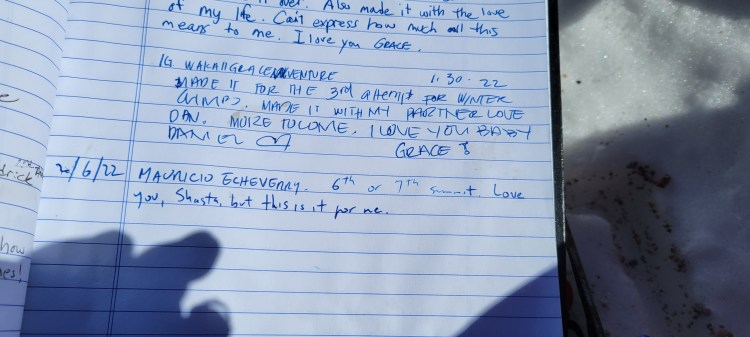
In the logbook at the top, I wrote the usual, my name and the date, but it is also customary to write a short message. Mine this time had this line:
“6th or 7th summit. I love you, Shasta, but this is it for me.»
I love all my experiences in this mountain, but I don’t have any more empty spaces inside that I need to fill up climbing it again.

