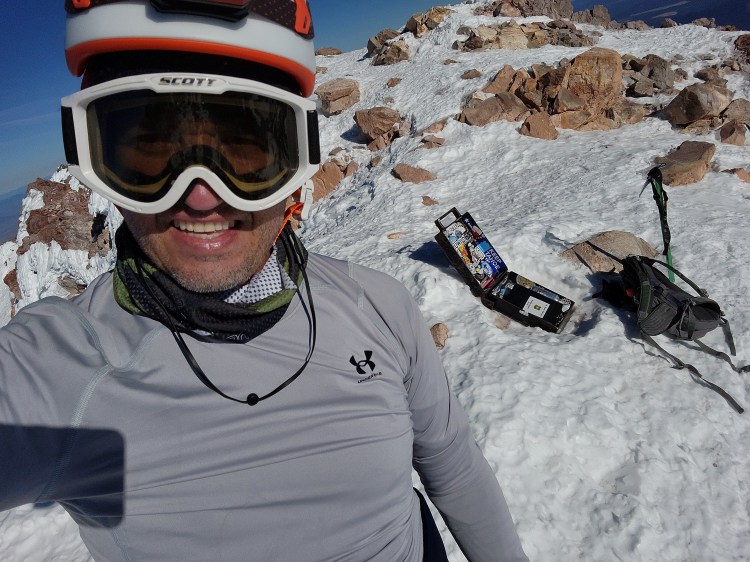
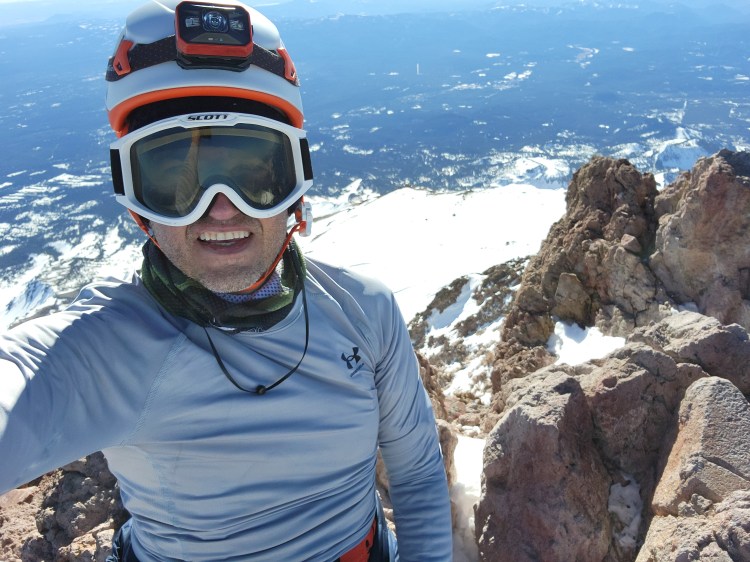
At 10:29 I got to the summit!!!
45 minutes from the top of misery hill.
The day was perfect. Not a cloud, no wind; but there were no people at the top either, so the photos I took were a couple of selfies.
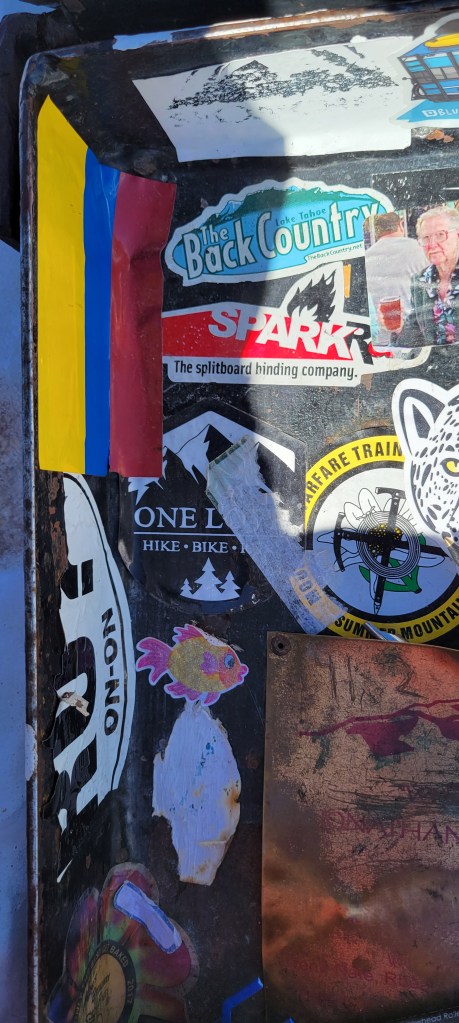
I signed the registry, as I had done 6 other times. The flag decal that I had made and stuck on that little box several years ago was still there. It still fills me with pride.
I started the descent about 15 or 20 minutes later.
A problem came up: Until that moment, I did not know that I had left my mountaineering glasses somewhere. I couldn’t remember whether I’d left them in the tent or in the car. The problem was that on one of my past climbs, the sunrays’ reflection on the snow burned my retinas to the point that they stung painfully. That time, I was able to get back to the car by constantly wiping my eyes with a bandana. When I got to town, I went straight away to a drugstore to buy eye-drops that would clean my eyes and calm the stinging. That discomfort lasted only a couple of days, but now on this trip, that experience was flying in my head. Fortunately, unlike that time, the googles I had now, had some polarization; the ones I had on that other occasion were clear, no UV protection.
First hard place: At the end of the small valley, going towards the top of the Misery Hill, I ended up going through a short, steep, and rocky part. I literally had to climb, even though it was only five or six steps. After that, the beginning of the descent of Misery Hill.
In these mountains, climbing down is generally a very fun thing to do, because you sit down and slide as if you were on a slide. It’s called “Glissading”; however, there are certain factors that are important: The first is the snow. If it is too soft, you can’t slide. If it is very hard, it becomes difficult to control your speed. The size of the backpack can also prevent or facilitate the slide; fortunately, at that point I had my small backpack on, so the pack wasn’t a problem at all. Lastly, it is advisable not to have crampons on when glissading, because those things can dig into the snow and make you lose control. In the first part of Misery Hill, it wasn’t possible to glissade because there were many rocks in the path that could be seen; however, about a third of the way down, I could see clean snow. In this mini-section, I came across a group of people who were going uphill. A little further down, I saw another guy from that group that had decided to stay behind and wait for them. The man asked me right away if I had lost a glove! Simply unbelievable that on two consecutive trips of mine to this mountain, something similar had happened to me, that I had lost something, and later someone found me to give me that. Well, I recovered the glove that I had lost at dawn; I continued my climb down.
The next section was clean with no visible rocks, so I sat down and tried to slide. It worked wonders for me! It was very easy to control the speed with my heels and the ice axe.
I soon reached the bottom of Misery Hill. That part is called ‘The Red Banks’, and it was the zone that I couldn’t see in the darkness of the early morning.
I kept sliding slowly across those rocks. That very short distance was very scary because it was too tight and quite steep. I was still able to slide down controlling the speed as much as possible, using the ice axe and my heels.
The next section is the main drop that gives this route its name, ‘Avalanche Gulch’.
Normally, I don’t like to glissade this section because I find it very steep. To me, it seems very dangerous because it is not very clear what to do if you can’t slow down. This is where most accidents have happened in this trail.
However, the success I had had up to that point in glissading Misery Hill, made me want to keep doing the same thing.
At the beginning it worked perfectly, but soon, the snow got a bit softer, and it started to be more of an effort to push myself and get momentum than what I was advancing.
Then I got up and began to take steps. Problem: The snow was too soft for me to slide on, but not soft enough for firm footing. I had to get my crampons and put them on my boots. This process takes about 5 minutes, so one tries to avoid doing it, or at least plan for efficiency by reading the terrain.
With crampons on, I started walking down. It is very different hiking down in this snow like this: much safer, firmer, more confident.

