Step-by-Step. The years that I’ve been doing this make me use that phrase as the most fundamental concept to reach the goal, to get to the summit. Step-by-Step.
I started slowly; I knew what was ahead of me, which was the absolutely most difficult section of the entire trail.
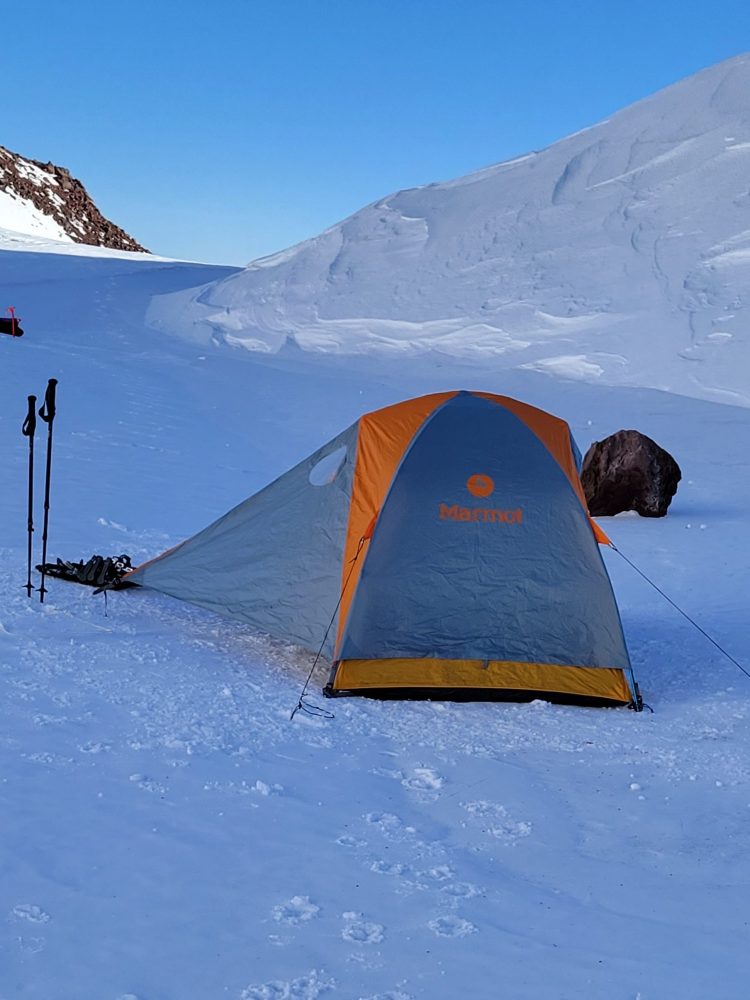
I’d been walking for about 40 minutes, and I could see that the people next to my tent hadn’t started their hike. I continued my ascent. Step-by-Step.
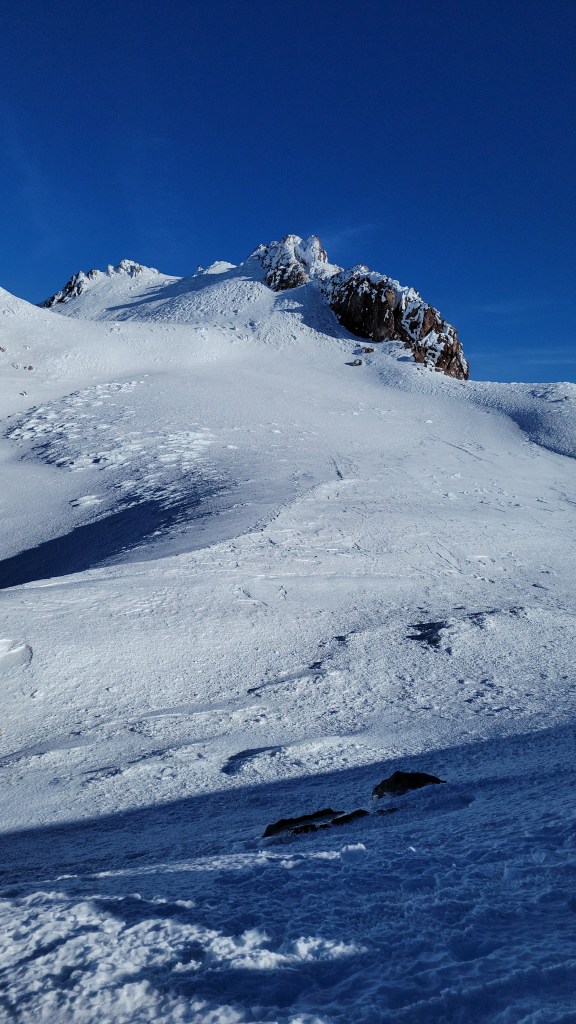
This section is climbed using the ice axe. The axe is used more as a safety tool than anything else, although it is also used as a lever of sorts as you are climbing. Its biggest value, though, is that it can be used to stop yourself if you slide and start falling on a steep hill.
One of the disadvantages of this trip was that since not many people had gone up before me, the path was not clearly marked by footprints; so, the traditional switchbacks of this section were non-existent on this particular weekend. This made me climb the steepest section in a straight line. Advantage: Less distance walked. Disadvantage: More walking time because you have to do it more slowly, and you have to stop to rest more times.
I still continued with my mantra, “step-by-step”.
At one of my rest breaks, I took off one of my gloves to try to use my phone. On hikes like this, it is normal to wear two pairs of gloves. It can get THAT cold.
Well, much later I realized that I had dropped that glove there, inadvertently. This caused me to walk through certain segments with the ice axe in my left hand, and my right hand in my pocket.
At one point, I could see the lights of the people where I had camped, moving up. I kept going. The night was still quite dark. My headlamp illuminated the ground very well and some distance in front of me, but it was not really possible in that darkness to notice the geographical features that I know in that area, and that can be used as a guide to know for sure that one is on the right track.
There were footprints, but they were not abundant and were rather faint. At one point, they didn’t give me clarity as to where to go next. I tried to look with my headlamp on and off to no avail. I decided to keep walking in the general direction I needed (up, obviously), but it turned out to lead to a dead end. The only option I had at that moment, was to go back down. I didn’t know for how long, but at that height a hundred feet cost time and effort. Still, my only option was to turn back a bit.
At that time, my scenario was something like this: I knew that eventually I would have to go to my right and up. I had a large rock formation to my right, without very clear places where I could cross it. In front of me, snow going downhill. I started to go down slowly. I saw some kind of gap in that block on my right, which looked like I could walk it. I got closer and saw that I would need to climb it using hands and feet. I took two steps, but since I had my crampons on, it was quite risky for me to continue doing that. Those crampons are great in the snow, but for bare rock climbing… I don’t know. I didn’t want to take that risk.
The action of going back those two little steps was not easy, but I was able to do it. I kept descending carefully towards the beginning (or end, depending on how you look at it) of that rock, to turn around it, and start climbing again.
It didn’t take long to get to that point. Restarting the climb, I saw a way to pass-through the new wall ahead of me.
It was good that it had been daylight for a little time.
The section that follows is called ‘Misery Hill’, and, oh, how appropriate that name is.
The most difficult section is supposed to be the one you just finished climbing; but the hill that follows is practically the same in terms of steepness and length.
With my getting lost in that last section, I lost track of those who were hiking before me. In the next section, Misery Hill, one can see a considerable distance in front. I saw no one. That made me think that they had given up and returned to their tent. I kept going, step by step.
…but the hill I had in front… Ugh, that thing looked worse than the previous one. I know it was nothing more than brain games, because it was no worse than the section I had just climbed. It was almost as steep, and almost as long, but a bit less in both counts. From the tent to where I was right now the distance was less than 5,000 feet (about a mile) away, with an elevation difference of 2,300 feet. What this means is that in that distance the slope is an average of 28 degrees.
The next section, from a purely mathematical point of view, was a little better: 2,450 feet away, with a height difference of 1,076 feet; it is a slightly less inclined triangle (26 average grades).
It is not a complicated section at all. The difficulty lies in the fatigue one has at that moment, and the altitude that multiplies the physical effort. On the other hand, the mind becomes the strongest motivation at that moment because, after everything you’ve done up to that point, and knowing how relatively little is left to summit the mountain, one practically eliminates any possibility of going back.
I reached the top of misery hill at 9:45 in the morning, that is, 7 hours after I started. Normally, it takes this time to climb to the summit from where I had pitched my tent, hiking slowly.
What follows is a refreshing bath for the mind: A short valley with a climb that isn’t too terrible at the end, and then the final ascent to the top, which is somewhat “hairy”, but very short.
Off to work. At that point, one is already at an altitude of 13,600 feet; 560 feet of ascent remain, which is covered in a distance of 2,000 feet.
I had been listening to a playlist on my phone for quite some time. It is a playlist of classical music by a german composer, Richard Strauss. I had a couple of very specific reasons to be listening to that music: One, that a young guy, son of a very dear friend of mine, had recommended this symphony. Two, that the thing is called ‘An Alpine Symphony’. Amongst the titles of the compositions in this symphony, we have: Sunrise, The Ascent, On The Glacier, Dangerous Moments, On the Summit. It was super cool to make my last steps summiting my mountain, listening to that movement of this symphone, the one that’s called ‘On the Summit’.